If you drive a three-wheeler for a living, you already know that daily expenses matter a lot. Fuel, maintenance, repairs and other costs can quickly reduce your daily earnings.
For years, petrol and CNG auto rickshaws have been a common choice for passenger transport. But now, e-rickshaws are becoming increasingly popular, especially for short-distance travel and local routes.
This brings up an important question:
If you are buying a three-wheeler for your business, should you choose an e-rickshaw or a traditional auto rickshaw?
Let’s compare them in simple terms.
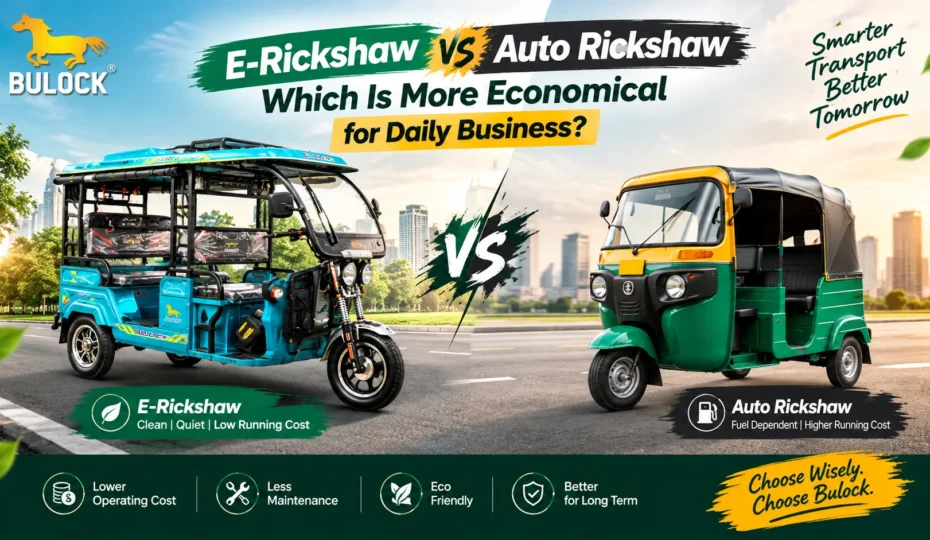
E-Rickshaw vs Auto Rickshaw: What’s the Difference?
The biggest difference is quite simple.
An e-rickshaw runs on electricity and uses a battery-powered motor, while a traditional auto rickshaw generally uses petrol, CNG or another fuel, depending on the vehicle.
Both can be used for passenger transportation and local business. But their running costs and maintenance requirements are different.
1. Which One Costs Less to Run Every Day?
This is probably the first thing a driver thinks about.
If you operate a petrol or CNG auto every day, a portion of your earnings goes towards fuel. The more kilometres you travel, the more you spend.
An e-rickshaw uses electricity instead of conventional fuel. Your charging cost will depend on your electricity rate, battery capacity, distance travelled and driving conditions.
For drivers who mainly travel short distances every day, an e-rickshaw can potentially reduce the amount spent on energy compared with a fuel-powered vehicle.
And when you are running a business every day, even a small saving can add up over time.
2. What About Maintenance?
Maintenance is another important expense for commercial vehicles.
A traditional auto rickshaw has an engine, engine oil, filters and several mechanical components that require regular servicing.
An e-rickshaw has a much simpler electric powertrain. There is no conventional engine or engine oil, which means some regular engine-related maintenance is avoided.
Of course, an e-rickshaw still needs proper care. Brakes, tyres, suspension, electrical components and the battery should all be checked regularly.
So, don’t think of an e-rickshaw as a vehicle that requires zero maintenance. It simply has a different maintenance requirement.
3. Fuel Pump or Charging Point?
Here’s another everyday difference.
With a petrol or CNG auto, you can stop at a fuel station, refuel and continue your journey relatively quickly.
With an e-rickshaw, you need to charge the battery.
If you have a suitable charging facility at home or your workplace, this can be quite convenient. You can charge the vehicle after finishing your day’s work and have it ready for the next morning.
However, charging time should be considered before buying. Make sure the charging arrangement fits your daily working schedule.
4. Battery Is an Important Part of an E-Rickshaw
If you are thinking about buying an e-rickshaw, don’t look only at the vehicle price.
The battery is one of the most important parts of the vehicle.
Battery performance and life can depend on:
- Battery technology
- Charging habits
- Daily usage
- Load
- Weather conditions
- Charger quality
- Maintenance
- Battery management system
Before purchasing, ask about the battery warranty, expected life, replacement cost and after-sales support.
A good battery and proper charging habits can make a big difference to your ownership experience.
5. Which One Is Better for Short-Distance Routes?
This is where e-rickshaws can make a lot of sense.
Many e-rickshaws are used for local routes such as:
- Railway station to nearby areas
- Local markets
- Residential areas
- School and college routes
- Village-to-market travel
- Short passenger trips
- Last-mile transportation
If most of your daily work happens within a limited area and you have access to charging, an e-rickshaw may fit your requirements well.
But if your work regularly involves longer distances and you need to refuel quickly, a conventional auto may be more convenient for your particular business.
6. Which One Can Give Better Business Economics?
There is no fixed answer because every driver’s business is different.
Imagine two drivers.
One driver travels mostly around the local market and railway station, covers relatively short distances and can charge the vehicle at home.
Another driver travels long distances throughout the day and does not have easy access to charging.
The first driver may find an e-rickshaw more suitable, while the second may prefer a conventional auto.
That’s why you should look at your own daily route and expenses instead of simply following someone else’s choice.
E-Rickshaw vs Auto Rickshaw: Quick Comparison
| E-Rickshaw | Auto Rickshaw |
|---|---|
| Runs on electricity | Usually runs on petrol, CNG or other fuel |
| Requires battery charging | Requires fuel refuelling |
| No engine oil | Engine oil required for conventional engines |
| Generally quieter | More engine noise |
| Simpler electric drivetrain | More engine-related components |
| Suitable for many short-distance routes | Suitable for short and longer routes |
| Charging time needs to be planned | Refuelling is generally quicker |
Don’t Compare Only the Purchase Price
A common mistake is to look at the initial price and stop there.
If you’re buying a vehicle for business, think about what it will cost you every day for the next few years.
Consider:
Purchase price + charging/fuel + maintenance + insurance + battery or major repair costs + financing + downtime
This gives you a much clearer picture of the actual cost of running the vehicle.
An e-rickshaw isn’t automatically the right choice for everyone, just as a petrol or CNG auto isn’t necessarily the cheapest option for every driver.
Your route, daily distance and charging facility matter.
Why Are More Drivers Considering E-Rickshaws?
For the right type of business, an e-rickshaw can offer some practical benefits.
Lower Dependence on Conventional Fuel
You don’t need petrol or CNG to operate an electric vehicle. The vehicle runs using stored electrical energy.
Convenient Charging
If you have a suitable charging point, you can charge the vehicle according to your own schedule.
Quieter Rides
Electric motors generally operate more quietly than conventional engines, making the ride more comfortable for many passengers and drivers.
Simple Electric Powertrain
With fewer conventional engine components, some regular maintenance requirements can be reduced.
Good Fit for Local Transportation
For short passenger trips and last-mile connectivity, e-rickshaws can be a practical option.
What Should You Check Before Buying an E-Rickshaw?
Don’t choose an e-rickshaw only because the price looks attractive.
Before buying, check:
- Battery type and capacity
- Actual range
- Charging time
- Motor performance
- Load capacity
- Battery warranty
- Vehicle warranty
- Service network
- Spare-parts availability
- Battery replacement support
- Build quality
- After-sales service
Remember, when a vehicle is your source of income, reliability matters just as much as price.
So, Which One Should You Choose?
There isn’t one answer that works for every driver.
A conventional auto rickshaw can make sense if you regularly travel longer distances and need quick refuelling.
An e-rickshaw can be a practical and economical option for drivers who mainly work on local routes and have convenient access to charging.
The best way to decide is to calculate your own numbers.
Check how much you currently spend on fuel, maintenance and repairs every month. Then compare that with the expected charging and maintenance costs of an e-rickshaw.
That simple calculation can tell you much more than a general comparison.
The Future of Local Transportation Is Changing
E-rickshaws are becoming an important part of local and last-mile transportation. For many drivers, the appeal is simple: less dependence on conventional fuel, potentially lower running expenses and a quieter driving experience.
If you’re planning to buy a new commercial three-wheeler, don’t just ask:
“Which vehicle is cheaper to buy?”
Ask:
“Which vehicle will cost me less to operate every day?”
That’s the comparison that really matters when your vehicle is also your business.
Thinking About an E-Rickshaw for Your Business?
Explore Bulock electric three-wheelers and choose a vehicle according to your route, passenger requirements and daily business needs.