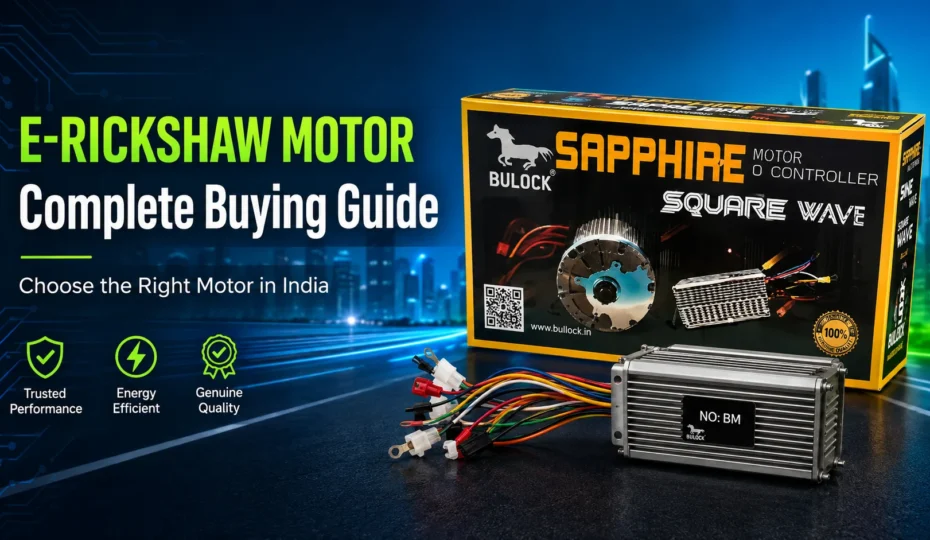
An e-rickshaw motor is one of the most important parts of an electric rickshaw. It is responsible for converting the battery’s electrical energy into the power needed to move the vehicle.
For an e-rickshaw driver or owner, the motor affects things like pickup, load capacity, climbing ability, battery consumption, and overall driving performance. That is why choosing the right motor is important when buying an electric rickshaw.
With electric three-wheelers becoming more popular across India, there are now many different motor options available. But choosing a motor is not simply about picking the one with the highest wattage. The motor should match the battery, controller, vehicle weight, and the way the e-rickshaw will be used.
What Is an E-Rickshaw Motor?
Simply put, the e-rickshaw motor is the part that makes the wheels move.
Unlike petrol or diesel rickshaws, an electric rickshaw does not use an engine that burns fuel. Instead, electricity stored in the battery is supplied to the motor through the controller.
The motor works together with several other components, including:
- Battery
- Motor controller
- Accelerator
- Wiring
- Differential
- Charging system
When the driver turns the accelerator, the controller regulates the power going from the battery to the motor. The motor then converts that electrical energy into movement.
Why Is the Motor So Important?
The motor has a direct effect on how an e-rickshaw performs on the road.
Better Pickup
A suitable motor can provide smooth acceleration when starting from a standstill. This is especially useful when the vehicle is carrying passengers or goods.
Carrying Loads
E-rickshaws are often used for commercial purposes. A motor needs enough power and torque to handle the vehicle’s intended load without putting unnecessary stress on the system.
Performance on Slopes
If you regularly drive on flyovers, slopes, or uneven roads, the motor’s torque becomes particularly important.
Battery Efficiency
A properly matched motor, battery, and controller can help the vehicle use its stored energy more effectively.
Smooth Driving
A good-quality motor can provide smoother and quieter operation, making the ride more comfortable for both the driver and passengers.
What Is a BLDC Motor?
You may have heard the term BLDC motor while looking for an e-rickshaw.
BLDC stands for Brushless DC Motor. These motors are commonly used in electric vehicles because they don’t use traditional mechanical brushes.
This can offer several benefits, including:
- Good efficiency
- Smooth operation
- Less mechanical wear
- Lower maintenance requirements
- Good torque
- Reliable performance
However, a BLDC motor should always be selected according to the complete vehicle setup. A good motor will only perform properly when it is matched with the right battery, controller, and drivetrain.
What Does Motor Wattage Mean?
When you see an e-rickshaw motor described as 850W, 1000W, 1200W, or 1500W, the wattage indicates its power rating.
Different power ratings can be suitable for different requirements.
| Motor Power | General Application |
|---|---|
| 850W | Light-duty applications |
| 900W | Regular city use |
| 1000W | Everyday passenger use |
| 1100W | Higher performance requirements |
| 1200W | Higher-load applications |
| 1500W | More demanding applications |
These are only general guidelines. The right motor depends on the complete design of the e-rickshaw.
BULOCK offers different motor configurations, including 850W, 900W, 1000W, 1100W, 1200W and 1500W options, depending on the vehicle and configuration.
How to Choose the Right E-Rickshaw Motor?
If you’re planning to buy an e-rickshaw or replace its motor, don’t make the decision based on wattage alone.
Here are some things worth checking.
1. Check the Battery
The motor must be compatible with the battery voltage used in the e-rickshaw.
For example, you shouldn’t randomly install a motor simply because it has a higher power rating. The battery and other electrical components also need to support it.
2. Think About Your Daily Load
How you use your e-rickshaw makes a big difference.
A passenger vehicle that regularly carries several people may have different requirements from an e-rickshaw used mainly for light cargo.
Think about your typical daily workload before choosing the motor.
3. Consider the Roads You Drive On
If you mostly drive on flat roads, your requirements may be different from someone who regularly drives on slopes or uneven roads.
For hilly routes, torque and motor performance become particularly important.
4. Check the Controller
The controller and motor need to work together properly.
Using an unsuitable controller can result in poor performance and may put unnecessary stress on the motor or other electrical components.
5. Consider Your Daily Running
If your e-rickshaw runs for many hours every day, look beyond the initial price.
Reliability, heat management, efficiency, and service support can become more important over the long term.
6. Look at After-Sales Support
A motor is not something you should buy only because it is cheap.
Check whether the manufacturer provides proper technical support, warranty information, spare parts, and service assistance.
E-Rickshaw Motor vs Petrol Engine
An electric rickshaw and a petrol rickshaw use completely different power systems.
A petrol engine burns fuel to generate power, while an electric motor uses electricity supplied by a battery.
One of the advantages of an electric drivetrain is its relatively simple mechanical design. There are fewer conventional engine components to maintain compared with a petrol engine.
However, the actual running cost of an e-rickshaw depends on several factors, including electricity prices, battery condition, driving habits, vehicle load, and maintenance.
Common E-Rickshaw Motor Problems
Like any mechanical or electrical component, an e-rickshaw motor can develop problems over time.
Some common signs include:
- Slow pickup
- Reduced power
- Unusual noise
- Excessive heating
- Vibration
- Sudden loss of power
- Poor overall performance
If you notice any of these issues, don’t immediately assume that the motor needs to be replaced.
The battery, controller, wiring, accelerator, and other components should also be checked by a qualified technician.
How to Take Care of Your E-Rickshaw Motor
Proper care can help maintain the performance of the motor for longer.
Avoid Overloading
Regularly carrying more weight than the vehicle is designed for can put additional pressure on the motor and drivetrain.
Check Electrical Connections
Loose or damaged wires and connections can cause performance problems. Regular inspection can help identify these issues early.
Pay Attention to Unusual Sounds
If your motor suddenly starts making unusual noises, it is better to get it checked rather than continue using it without inspection.
Keep an Eye on Heating
Some heating during operation can be normal, but excessive or unusual heating should be investigated.
Follow the Manufacturer’s Recommendations
Always follow the manufacturer’s instructions regarding motor specifications, compatible components, servicing, and maintenance.
Why Choose BULOCK for Your E-Rickshaw?
Choosing an e-rickshaw is a long-term business decision, so the motor and overall vehicle configuration both matter.
BULOCK Motors offers different electric three-wheeler configurations with a range of motor options. Depending on the model, customers can choose from different power levels to suit their requirements.
For example, the BULOCK BL 2 is available with motor options including 1200W, 1250W, 1500W, and 1800W, depending on the configuration.
This gives customers more flexibility when selecting an e-rickshaw according to their expected load, road conditions, and daily usage.
Frequently Asked Questions
Which motor is best for an e-rickshaw?
There isn’t one motor that is perfect for every e-rickshaw. The right option depends on the vehicle weight, battery, controller, load, road conditions, and daily usage.
Is a BLDC motor good for an e-rickshaw?
Yes. BLDC motors are widely used in electric vehicles because they offer good efficiency, smooth operation, and reduced mechanical wear.
Does a higher-wattage motor mean a better e-rickshaw?
Not always. A higher-wattage motor is not automatically better. The motor needs to be compatible with the battery, controller, drivetrain, and overall vehicle design.
What should I check before buying an e-rickshaw motor?
Check the motor’s power rating, voltage, compatibility with the controller and battery, expected load, road conditions, warranty, service support, and availability of spare parts.
How long does an e-rickshaw motor last?
Motor life depends on factors such as usage, load, road conditions, maintenance, electrical system compatibility, and product quality. Proper use and regular inspection can help maintain performance.
Final Thoughts
The e-rickshaw motor is at the heart of an electric three-wheeler. It plays an important role in acceleration, load carrying, efficiency, and overall driving performance.
But choosing a motor isn’t just about finding the highest wattage or the cheapest option. The motor should be properly matched with the battery, controller, vehicle weight, load, and road conditions.
If you’re planning to buy an electric rickshaw for passenger transportation or commercial use, take the time to understand the motor and the complete vehicle configuration.
With different motor and vehicle options available, BULOCK Motors aims to provide electric three-wheeler solutions suited to different business and transportation requirements.