
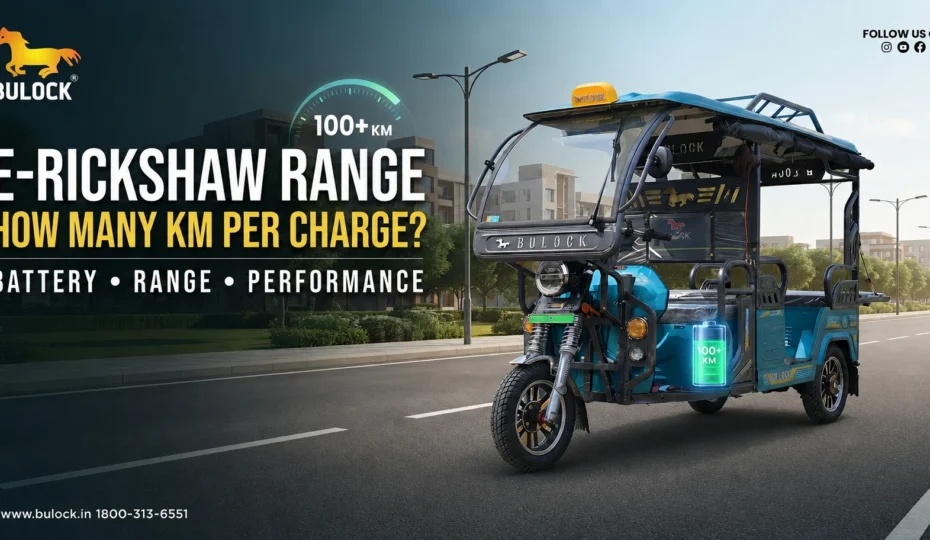
If you’re thinking about buying an e-rickshaw, one of the first things you’ll probably want to know is, “How far can it travel on a single charge?”
This is an important question, especially if you’re planning to use the e-rickshaw for daily passenger transport or as a source of income. A good range means fewer charging stops and more time on the road.
But the actual range of an e-rickshaw depends on several things, including the battery, passenger load, road conditions, driving habits, and maintenance.
How Many Kilometres Can an E-Rickshaw Travel?
Generally, an e-rickshaw can offer around 80 to 150 km of range on a single charge, depending on the model and battery configuration.
However, don’t take this number as a fixed figure. The range you get in everyday use can be different from the range mentioned in the vehicle specifications.
For example, an e-rickshaw carrying a full passenger load on busy roads with frequent stops may give less range than the same vehicle running on a smooth road with a lighter load.
What Affects E-Rickshaw Range?
There isn’t just one reason behind the range of an e-rickshaw. Several factors work together.
1. Battery Capacity
The battery is one of the most important parts of an electric rickshaw. A battery with higher capacity can store more energy and can generally help the vehicle travel a longer distance.
When comparing two e-rickshaws, don’t look only at the battery voltage. Check the battery capacity, charging time, warranty, and expected performance as well.
2. Number of Passengers
The more weight the vehicle carries, the more energy the motor needs.
If you regularly carry four passengers along with luggage, your actual range may be lower than the manufacturer’s claimed range.
This is why it’s a good idea to choose an e-rickshaw according to your normal daily usage rather than choosing one based only on its advertised range.
3. Road and Traffic Conditions
Road conditions can make a big difference.
An e-rickshaw travelling on a smooth and relatively flat road will generally use less energy than one travelling on uneven roads, slopes, or heavily congested routes.
Frequent stopping and starting in traffic can also increase battery consumption.
4. Driving Style
Your driving habits can also affect battery performance.
Sudden acceleration, unnecessary speeding, and frequent hard braking can use more energy. Smooth acceleration and maintaining a steady speed can help you get better efficiency from the battery.
5. Tyre Pressure
This may seem like a small thing, but tyre pressure matters.
Under-inflated tyres create more resistance, which means the motor has to work harder. Checking your tyre pressure regularly can help maintain better efficiency.
6. Battery Condition
A new battery and an older battery may not deliver exactly the same performance.
As a battery gets older, its ability to hold charge can gradually decrease. Proper charging and regular maintenance can help you get better performance throughout its useful life.
How Can You Get Better Range From Your E-Rickshaw?
You don’t always need a bigger battery to improve range. Good driving and maintenance habits can also make a difference.
Here are some simple tips:
- Don’t overload the vehicle.
- Keep the tyres properly inflated.
- Avoid sudden acceleration.
- Maintain a steady driving speed.
- Get the vehicle serviced regularly.
- Use the charger recommended by the manufacturer.
- Follow the correct charging instructions.
- Check the brakes, tyres, and electrical components regularly.
- Avoid unnecessary idling.
These small habits can help you get the best possible performance from your e-rickshaw.
Is the Claimed Range the Same as Real-World Range?
Not always.
The range mentioned by a manufacturer is usually based on specific testing conditions. In everyday life, things are different. You may have traffic, passengers, uneven roads, speed changes, weather conditions, and frequent stops.
Because of this, the actual range can be different from the claimed range.
When you’re planning to buy an e-rickshaw, ask the dealer or manufacturer about the expected real-world range and the conditions under which the claimed range was measured.
How Much Range Do You Actually Need?
The answer depends on your daily work.
Suppose you normally travel around 50–60 km a day. You don’t necessarily need to buy the e-rickshaw with the highest possible range. Instead, look for a model that comfortably covers your daily distance while leaving some extra range for unexpected trips.
If you drive long distances every day, a higher-capacity battery may be more suitable.
The important thing is to choose a vehicle based on your actual daily requirements.
Why Range Is Important for E-Rickshaw Drivers
For many drivers, an e-rickshaw is not just a vehicle—it’s a source of income.
If the vehicle needs to be charged frequently during the working day, valuable working time can be lost. A suitable range allows drivers to spend more time carrying passengers and less time waiting for the battery to charge.
A good e-rickshaw should therefore offer a balance of:
- Good range
- Reliable battery
- Reasonable charging time
- Comfortable passenger capacity
- Strong build quality
- Reliable motor performance
- Good after-sales support
What Should You Check Before Buying an E-Rickshaw?
Before making your decision, don’t look at the range alone. Ask about:
- Battery capacity
- Claimed and real-world range
- Charging time
- Battery warranty
- Motor power
- Passenger/load capacity
- Service support
- Availability of spare parts
- Overall maintenance requirements
A reliable manufacturer or authorised dealer should be able to explain these details clearly.
Final Thoughts
So, how many kilometres can an e-rickshaw travel on one charge?
In general, many e-rickshaws offer around 80–150 km of claimed range, but the actual distance can vary depending on the battery, passenger load, road conditions, traffic, driving style, and battery condition.
If you’re buying an e-rickshaw for business, don’t choose a model simply because it has the highest advertised range. Look at the complete picture—battery quality, range, charging time, durability, running requirements, warranty, and after-sales service.
The right e-rickshaw is the one that fits your daily route and business needs while giving you dependable performance every day.
Frequently Asked Questions
How far can an e-rickshaw travel on a single charge?
Depending on the model and battery, an e-rickshaw may offer around 80–150 km on a single charge under suitable conditions. Actual range can vary.
Does carrying more passengers reduce the range?
Yes. A heavier passenger or cargo load requires more energy from the motor, which can reduce the vehicle’s range.
How can I improve my e-rickshaw’s range?
Avoid overloading, maintain proper tyre pressure, drive smoothly, follow recommended charging practices, and keep the vehicle properly serviced.
Does battery age affect e-rickshaw range?
Yes. As a battery gets older, its ability to store energy can gradually decrease, which may affect the distance it can travel on a full charge.
Should I buy an e-rickshaw with the highest range?
Not necessarily. Choose a range that comfortably meets your daily travel requirements. Also consider battery quality, charging time, vehicle durability, warranty, and service support.