
The Ultimate Buyer’s Guide to Selecting an E-Rickshaw Battery
The E-Rickshaw sector is revolutionizing transportation and commuting in India. As the price of petrol increases and public awareness regarding the importance of environment conservation grows, E-Rickshaws are gaining popularity among both drivers as well as entrepreneurs/ fleet owners.
When you buy an E-Rickshaw, one of the most crucial factors to consider is the battery it runs on. The battery isn’t just another part of the vehicle-it’s its power source, performance contributor, and one of the biggest factors that contributes to its operational cost. Today, there are broadly two types of batteries used for E-Rickshaws: Lead-Acid batteries and Lithium-Ion batteries.
But which one do you pick? Is the higher cost of Lithium-Ion batteries justifiable, or should you stick to the traditional and much cheaper lead-acid alternative?
In this guide, we’ll compare both battery technologies in detail to help you make an informed decision.
Disadvantages of Lead-Acid Batteries
- Heavy Weight: Lead-acid batteries are bulkier and heavier as compared to Lithium batteries. This can be a disadvantage for vehicle efficiency and range of the E-Rickshaw.
- Shorter Lifespan: Normal life span of lead-acid battery is between 12 and 24 months.
- Longer Charging Time: Recharging capacity of this battery is between 8 to 12 hours.
- Frequent Maintenance: It requires frequent maintenance. Terminals have to be kept clean; water level needs to be checked; charging habits have to be monitored; etc.
- Reduced Performance Over Time: Once the battery is completely discharged, its performance reduces steadily with each use. Charging does not instantly recharge the battery.
Understanding Lithium-Ion Batteries Lithium-ion batteries are the latest trend in Electric vehicles. These batteries have evolved tremendously over time and are being widely used in E-Rickshaws as well.
Advantages of Lithium Batteries
- Longer Lifespan: These lithium batteries have an average life of 4 to 6 years, but there are quality batteries that can easily last between 8 to 12 years as well. This gives more mileage to a driver and it saves a significant amount on battery replacement over time.
- Faster Charging: Lithium batteries charge faster than lead-acid batteries. Charging time of a quality lithium battery is around 3 to 5 hours depending on the power of the charger.
- Lightweight Design: Lithium batteries are much lighter. This benefits the driver in the long run as it results in better acceleration, improved efficiency, higher range of vehicle and reduced stress on the vehicle’s suspension and chassis.
- Better Driving Range: Since lithium batteries are energy-efficient, you can get two to three times more kilometers per charge as compared to batteries with lower energy efficiency. This helps the driver
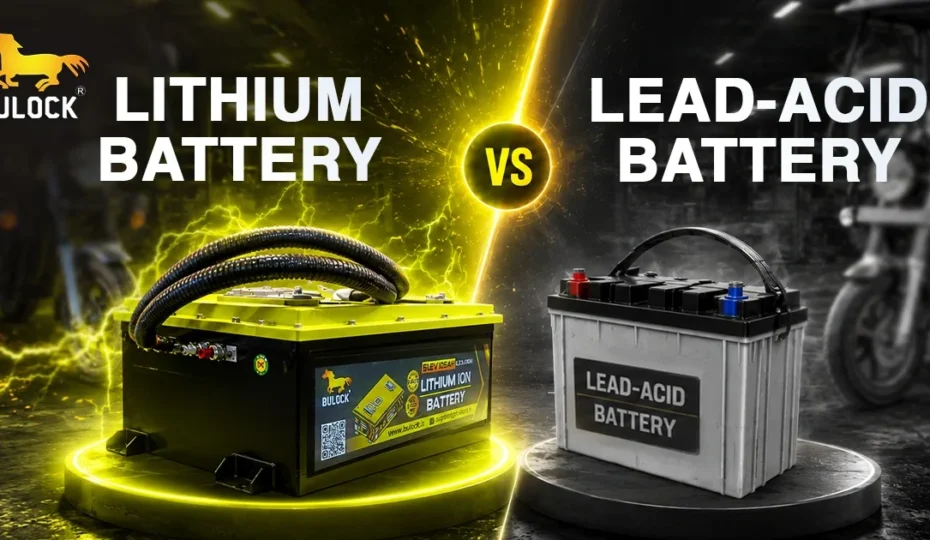
Lithium Battery vs Lead-Acid Battery: Head-to-Head Comparison
| Feature | Lithium Battery | Lead-Acid Battery |
| Initial Cost | Higher | Lower |
| Lifespan | 4–6 Years | 1–2 Years |
| Charging Time | 3–5 Hours | 8–12 Hours |
| Weight | Lightweight | Heavy |
| Maintenance | Minimal | Regular Maintenance |
| Efficiency | High | Moderate |
| Driving Range | Longer | Shorter |
| Performance | Consistent | Declines Over Time |
| Replacement Frequency | Low | High |
| Long-Term Cost | Lower | Higher |
Which Battery Offers More Profitability?
When it comes to battery selection, many buyers usually look at only the price of the battery. But as businesspeople, it is important to look at the Total Cost of Ownership (TCO).
Let’s take the example of a popular multi-purpose E-Rickshaw:
While a lead-acid battery may be cheaper initially, you would have to change the lead-acid battery every 1–2 years. Lithium batteries, on the other hand, are associated with a higher price tag and it remains usable for several years. The lithium battery will offer you:
- Better mileage
- Less downtime
- Lower maintenance expenses
- Faster charging
- Higher daily earning potential
The TCO calculation will always show that the lithium battery is the better choice.

Impact on Daily Earnings
For E-Rickshaw drivers, battery performance is a currency. A vehicle that provides:
- More range,
- Faster charging,
- Better load-carrying capability
can get in more trips in a single day. This can impact daily earnings as you are:
- Getting more revenue,
- Providing better customer service,
- Reducing waiting time,
- Increasing operational efficiency.
In some cases, the additional earnings generated by a lithium battery can even recover the higher purchase cost over the vehicle’s lifetime.
Environmental Benefits
The need for a sustainable approach to transport is growing constantly. Each user can benefit from the lithium batteries’ total package of features and advantages such as:
• Higher energy efficiency
• Lower energy loss
• Lower environmental impact
• Support for clean urban mobility
Which Battery Is Best for Different Users?
Choose Lead-Acid Battery If:
✔ You have a limited budget
✔ Your daily travel distance is relatively low
✔ You don’t mind regular maintenance
✔ Initial cost is your primary concern
Choose Lithium Battery If:
✔ You want maximum profitability
✔ You travel long distances daily
✔ You need faster charging
✔ You prefer low maintenance
✔ You want long-term savings
✔ You operate a commercial fleet
✔ You want the latest technology
What’s the way forward for E-Rickshaw Batteries?
Well, the future is lithium. With new and improved methods of battery making, lithium batteries are becoming:
- Affordable
- Efficient
- Durable
- Fast charging Most E- Rickshaw owners will likely be using lithium batteries. The trend of lithium-powered E-Rickshaws will only accelerate onwards.
Frequently Asked Questions
Which battery lasts longer in an E-Rickshaw?
Lithium batteries generally last 4–6 years, while lead-acid batteries typically last 1–2 years.
Which battery charges faster?
Lithium batteries charge significantly faster than lead-acid batteries.
Which battery requires less maintenance?
Lithium batteries are virtually maintenance-free compared to lead-acid batteries.
Is a lithium battery worth the extra cost?
For most commercial users, yes. The longer lifespan, higher efficiency, and lower maintenance often result in better long-term savings.
Which battery provides better mileage?
Lithium batteries generally offer greater range and better energy efficiency.
Conclusion
Lead-acid and lithium are both good batteries, with the former being cheaper and better suited to lower usage and budget owners. If you need better performance, life, faster charging, low maintenance, and more earning, you should go for a lithium battery. The E-Rickshaw industry is developing, moving towards the future, and it’s lithium that’s leading the way with efficiency, reliability, and sustainability. So, don’t invest in just any battery. Make the right battery bet and earn more, spend less and succeed in the future.